

Ciao, piacere di conoscerti…nice to meet you. Every time I drive from Rome towards Abruzzo, there’s a motorway sign where Lazio ends and my region begins. I count down…five, four, three, two, one…and the moment we cross it I honk the horn and shout “back in Abruzzo!” My kids tease me about it. I confess I do it even when I’m alone in the car. That’s the region this guide is about, written by someone born and raised in Pescara and still can’t cross that border calmly.
In short: Abruzzo sits one hour east of Rome: mountains and sea close enough that you can ski in the morning and have an aperitivo by the Adriatic the same evening. About a third of the region is protected land across three national parks. Come in spring or September, rent a car, pick one or two bases instead of racing around, and eat arrosticini at least once. This travel guide covers how to get here, when to come, where to go first, what to eat, and where to stay.
Where Is Abruzzo and How Do You Get Here
Abruzzo is the middle of Italy, on the Adriatic side: the Apennine mountains on one edge, the sea on the other, and everything in between packed into four provinces…L’Aquila, Teramo, Pescara (my hometown), and Chieti. From Rome you’re at the regional border in about an hour by car. I do that drive constantly, sometimes just for one lunch or a walk.
The region has its own airport, Abruzzo Airport in Pescara. It’s small, with direct routes served mainly by Ryanair and Wizz Air, to a mix of Italian cities and European destinations. If you can’t find a route that works, fly into Rome and drive across: the motorway climbs through the mountains and drops you on the coast in around two hours, and the drive itself is part of the trip.
Once you’re here, rent a car. Trains and buses exist, and the coastal railway works well, but the villages and the mountains are where Abruzzo lives, and public transport up there is thin. One exception worth taking for its own sake: the train from Pescara to Sulmona, where you watch the landscape change from beach to peaks out the window.
The mistake almost every first-time visitor makes, and I say this with love: underestimating how big the region is. Basing yourself in one spot and day-tripping everywhere is feasible, but it’s tiring. Pick one base on the coast and one in the mountains and you’ll see more by driving less.
When to Come
If you ask me for one answer: spring. The mountains are green, the towns are awake, and you have the trails almost to yourself. Personally I also love summer…it’s sagra season, and my perfect day is a beach morning and a mountain afternoon. September keeps most of summer’s warmth without the August crowds and August prices.
And winter is underrated. Snow on the villages, cold outside, and I love to be at home with my fireplace. If you ski, even better: Roccaraso and the Alto Sangro area form the largest ski district in the Apennines. For a proper month-by-month breakdown, I wrote a full guide on the best time to visit Abruzzo.
Where to Go First
The coast
Pescara is where I grew up, and as a teenager I worked as a lifeguard on its beach. It’s about seven kilometres of sand, lined with the stabilimenti, the beach clubs that organise summer life here…in my high-school years each school even had “its” beach club, and you went where your crowd was. Pescara is the commercial, lively choice: lots to do, good nightlife, easy trains.
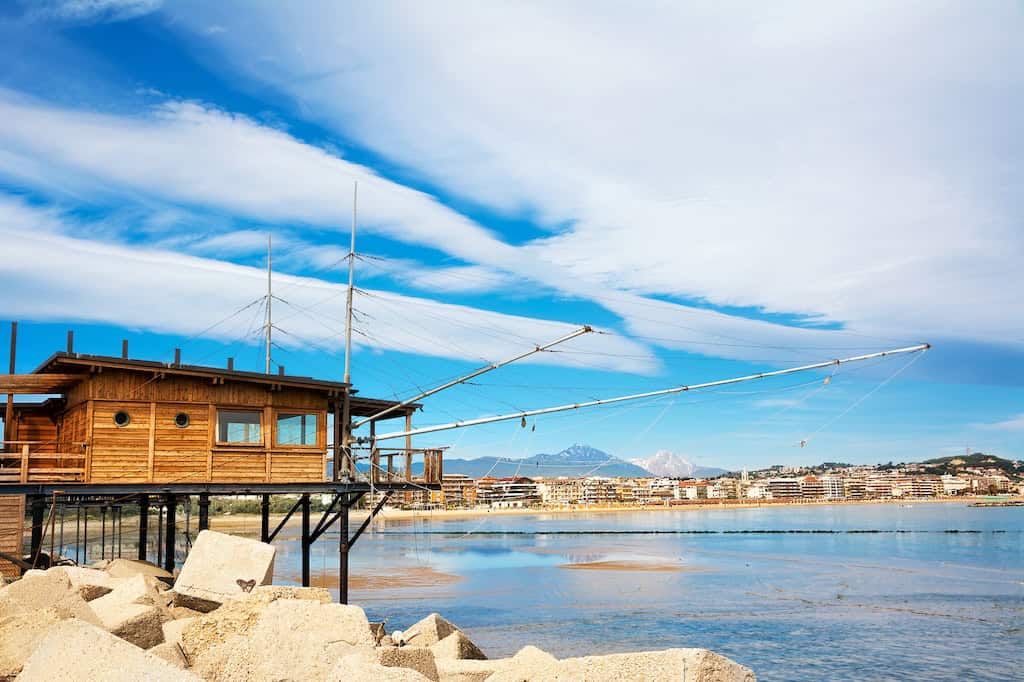
For natural beauty, my honest answer is the southern coast, in the province of Chieti. Punta Aderci, just outside Vasto, is the beach I point people to when they want the wild version of the Adriatic. On the way down you’ll pass the trabocchi, the old wooden fishing platforms on stilts that this stretch of coast is named after.
The mountains
They call Abruzzo the greenest region in Europe, and it’s not marketing: three national parks, a regional park and dozens of reserves protect roughly a third of the territory. Gran Sasso is the one I know best. The cable car from Fonte Cerreto takes you up to Campo Imperatore at about 2,130 metres, a high plain so bare and wide it doesn’t feel like Italy at all. In peak summer the road up gets capped for numbers, so the cable car is often the easier way in. A few years ago I summited Corno Grande, the highest peak of the Apennines, and it’s still one of my proudest days in the mountains.
Further south there’s the Maiella, wilder and quieter, and the Abruzzo, Lazio and Molise National Park around Pescasseroli, one of my favorite villages and the home of the Marsican brown bear. Seeing one is rare and should stay that way: keep your distance, use a zoom, and check with park offices about trail conditions before long hikes.
The towns and villages
This is where I have to hold myself back, because I could list fifty. Sulmona is the town of confetti, the sugared almonds Italians give at weddings, and its Easter ritual is one of the great spectacles of the region (more on that below). Scanno sits above a lake that really is heart-shaped when you climb the Sentiero del Cuore to the viewpoint…about 45 minutes up from the shore, and worth every step, though the viewpoint has no railing so mind your footing.
Higher up, Santo Stefano di Sessanio is a restored medieval village where the hotel is spread through the old houses. From there it’s a short drive to Rocca Calascio, a ruined fortress at 1,460 metres, one of the highest in Italy. Pair either with Castelli, the ceramics town under the Gran Sasso cliffs, and you have one of the best days out in central Italy.
And then there’s Penne, my own town, and places like Tagliacozzo that I keep going back to. My honest position on which ones are overrated: none. Abruzzo is still to be discovered; most of it is underrated.
What to Eat and Drink
Start with arrosticini: thin skewers of sheep meat grilled over coals, eaten by the dozen with bread and olive oil. The best I’ve ever had are at Da Stefano in Conaprato, a tiny place in the countryside between Penne and Farindola…on summer weekends it fills with locals, so book. Then there’s pasta alla chitarra, square-cut spaghetti made on a wooden frame strung with wires, usually served with a lamb ragù.
Olive oil is personal for me. My family’s land at Alanno, my father’s village in the countryside behind Pescara, still produces our own oil, the way it did when I was a kid riding on the tractor. When you see “olio extravergine” from small Abruzzo producers, buy it.
For wine, the red is Montepulciano d’Abruzzo…I can smell home when I drink it. The whites to look for are Pecorino, Passerina and Trebbiano. And in summer, follow the sagre: hundreds of village food festivals, each dedicated to one dish. My method is simple: just plan and go. The sagra in Pretoro is a favorite of mine. If you want something hands-on instead, you can book a cooking class in a local home in Pescara, or go out with a truffle hunter and his dogs on a truffle hunt near Teramo.
Festivals Worth Planning Around
Abruzzo keeps its traditions alive in a way that surprises visitors. A few dates worth building a trip around:
- Easter Sunday, Sulmona: La Madonna che Scappa. At midday in Piazza Garibaldi, the statue of Mary “runs” across the square to meet her risen son, her black veil falls, and doves fly. The whole town holds its breath.
- 1 May, Cocullo: the Festa dei Serpari, where a statue of San Domenico is carried in procession draped with live snakes, handled by the village’s serpari. Yes, really.
- 16 January, Fara Filiorum Petri: the Farchie, giant bundles of reeds around ten metres tall, raised and burned for Sant’Antonio Abate. Winter fire ritual at its best.
- July, Pescara: Pescara Jazz, born in 1969 as Italy’s first summer jazz festival, and the Festa di Sant’Andrea on the last Sunday of July, when the fishermen carry their patron saint out to sea by boat and fireworks close the feast.
- 23 to 30 August, L’Aquila: the Perdonanza Celestiniana, a forgiveness celebration founded by Pope Celestine V in 1294 and now on UNESCO’s intangible heritage list, with the opening of the Holy Door at Collemaggio.
Where to Stay
On the coast you’ll find everything from simple B&Bs to seafront hotels, and booking is easy. Inland, the two options I push people towards are agriturismi…working farms with rooms and their own food, often better value if you contact them directly…and the alberghi diffusi, villages where the hotel rooms are scattered through restored old houses. The most famous is Sextantio in Santo Stefano di Sessanio, where you sleep inside the medieval village itself.
And then there’s my own place. In 2008 an agent in Penne showed me a house that was literally falling apart. I barely knew the town, but I had a vision, bought it anyway, and rebuilt it exactly as I’d imagined. It became my shelter every time I came back from living abroad, and today I host guests there through my Airbnb in Penne, right in the heart of the old town. I love meeting the people who stay.
Practical Things Nobody Tells You
Mountain roads take longer than the map says: hairpins, tractors, and views you’ll want to stop for. Add margin to every drive. In the old town centres watch for ZTL signs (limited traffic zones)…drive into one and the camera will find you months later at home.
Carry some cash. Cards work almost everywhere now, but in the smallest villages and at sagre, cash is still king. The emergency number in Italy is 112. And a little Italian goes a long way here: grazie, per favore, and un altro vino, per favore. People will meet you more than halfway…Abruzzesi are reserved for about five minutes, then you’re at their table.
Thinking About More Than a Holiday?
It happens to a lot of my readers: they come for a week, and by day three they’re photographing agency windows. If that’s you, I’ve written an honest guide to houses for sale in Abruzzo and a town-by-town index of what property and daily life really cost here. I’ve personally helped foreigners buy homes, plan moves and even trace their Abruzzese ancestors…if you want that kind of help, here’s how to work with me.
Questions I Get About Visiting Abruzzo
Is Abruzzo worth visiting?
Every non-Italian friend I’ve brought here has come back with the same reaction: shock at how beautiful it is, and how unknown. If you’ve already done Rome, Florence and Venice and want the Italy where people actually live, this is it. Abruzzo is still to be discovered; most of it is underrated.
How many days do you need in Abruzzo?
A week is the sweet spot: a few days on the coast, a few in the mountains. The region is bigger than it looks, so two bases beat one. A long weekend works if you focus on one area only.
Do you need a car in Abruzzo?
For the villages and the mountains, yes. The coastal train line is good, and Pescara to Sulmona is a beautiful ride, but the places that make Abruzzo special mostly aren’t on a railway.
When is the best time to visit Abruzzo?
Spring for green mountains and empty trails, September for warm sea without the crowds. Summer if you want the sagre and beach life, winter if you ski or love a fireplace. Full breakdown in my seasonal guide.
Your Next Step
So now you know how to get here, when to come and where to point the car. The next question is how to string it together…and for that I’ve built ready-made routes in my guide to planning the perfect Abruzzo itinerary, with 7, 10 and 14-day options. Read that, pick your days, and I’ll see you on the other side of that motorway sign. Buon viaggio!
